Sleeping
We sleep outdoors in the desert. A private tent is possible, as is sleeping under the open sky. What matters is that you stay warm at night and recover for the following day.
DEEP LAND / NATURE RETREAT
SAHARA
Vastness. Silence. Simplicity.
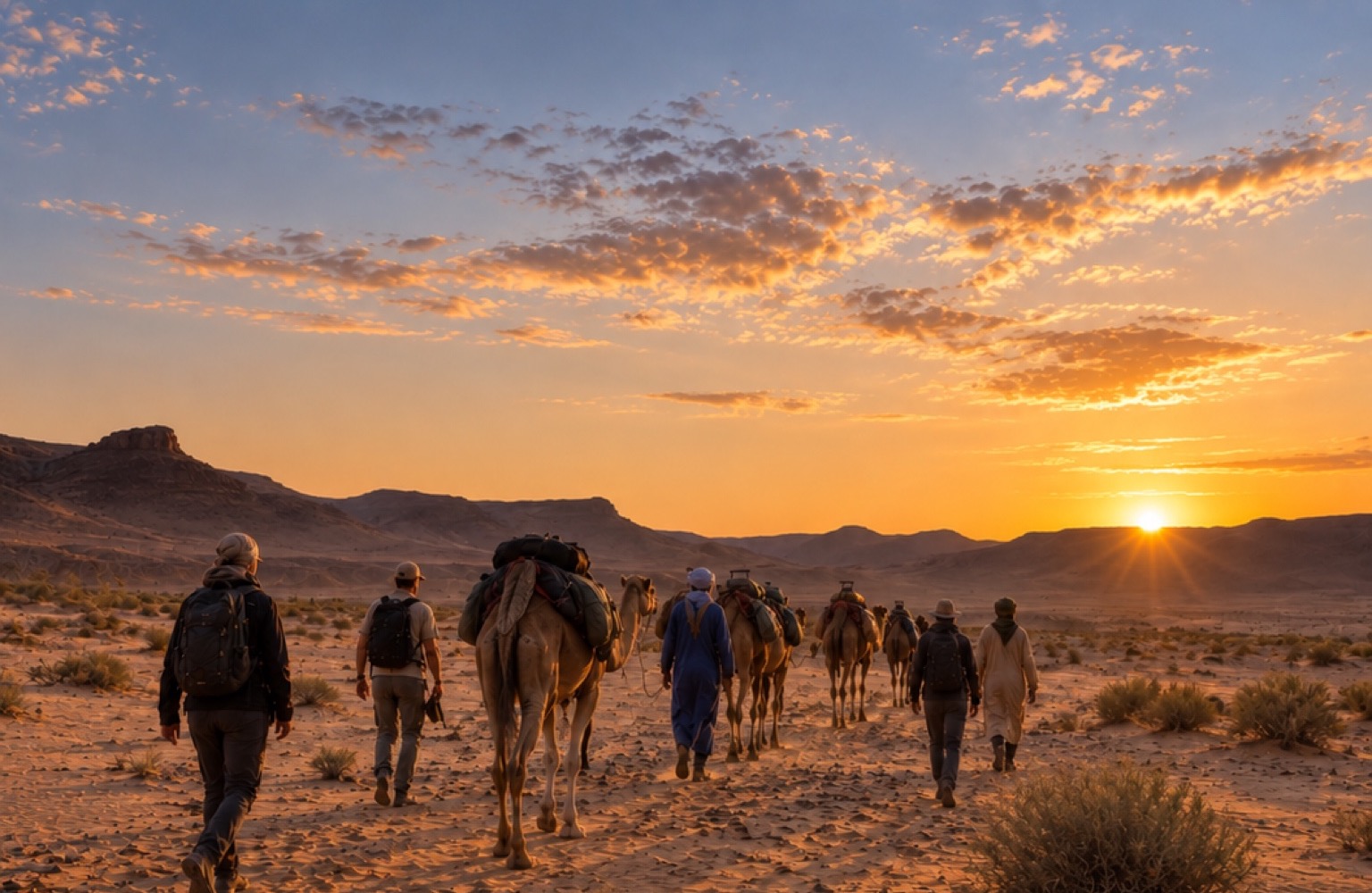
For six days, we travel on foot with a small caravan through the Moroccan Sahara. We walk for several hours each day, take breaks and make camp in a new place in the afternoon.
Our main luggage, equipment and provisions are carried by dromedaries. We live in the desert as a small group together with our local guides and continue the journey the next morning.
With each day, the rhythm becomes simpler: walk, rest, eat, arrive, set up camp, observe, talk, sleep.
Time opens up. For the landscape. For conversations. For silence. And for whatever is present along the way.
Not visiting the Sahara. Living in it for a few days.
DEEP LAND deliberately travels in very small groups. Four participants create a personal setting, flexibility along the way and enough room to experience the landscape at your own pace.
The small group is not an exclusive extra. It is part of how this journey works.
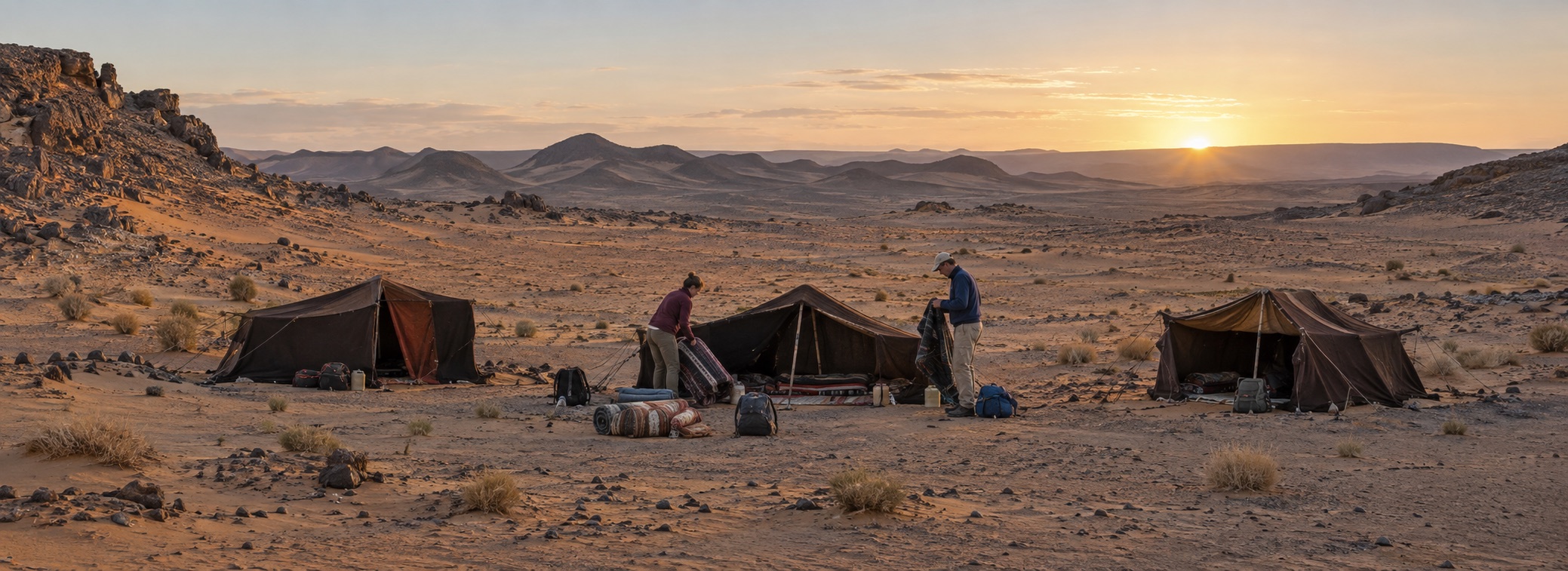
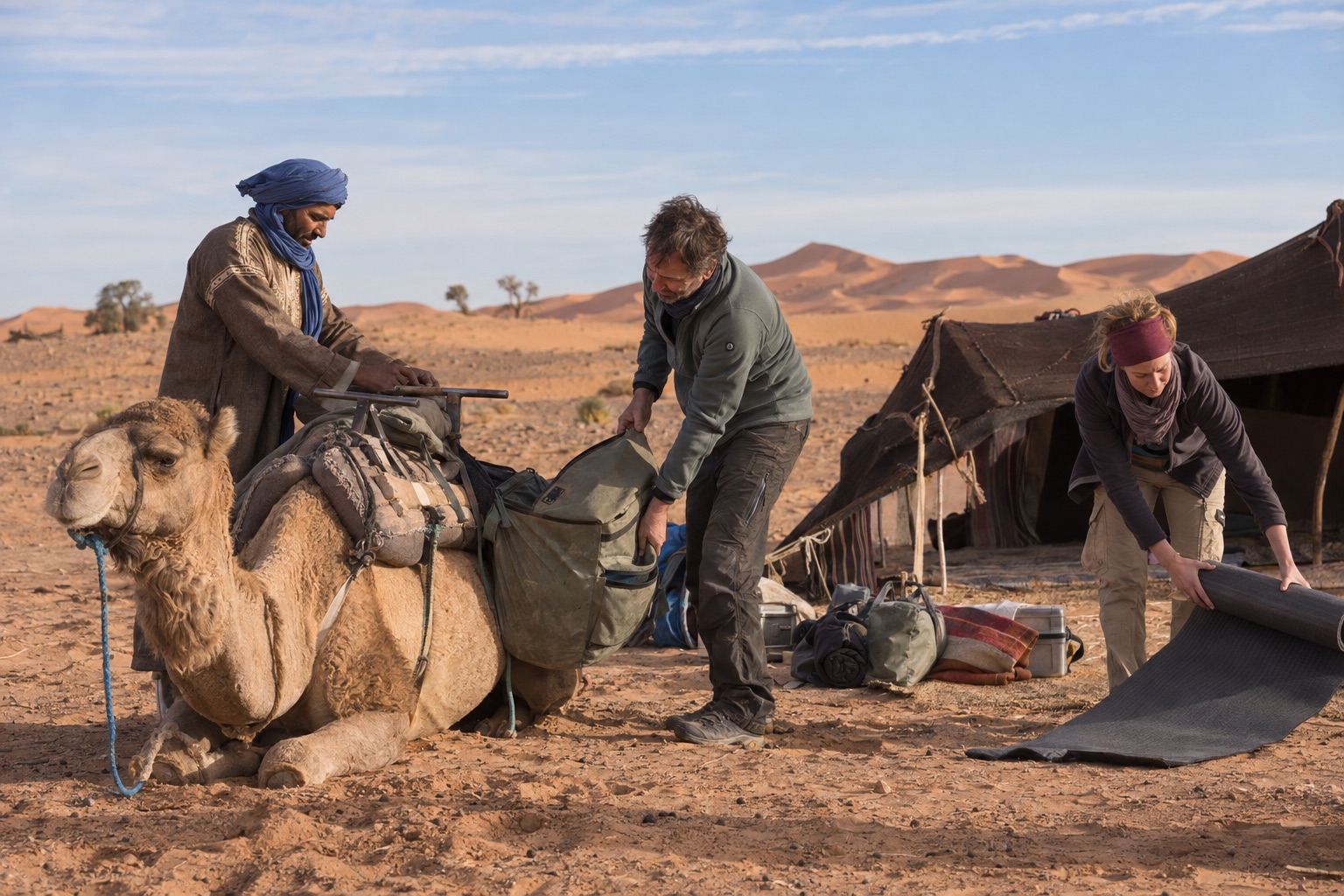
We begin early. After breakfast, we take down the camp together and continue with the caravan.
We walk for four to five hours, usually covering around 12 to 15 kilometres. In between, we take breaks and make time for the landscape.
In the afternoon, we reach our new campsite and set up camp. Afterwards there is time to rest, explore or simply be on your own. None of this is a programme.
We eat together, sit with one another or withdraw for a while. As darkness falls, the camp grows quiet. The next morning, we move on.
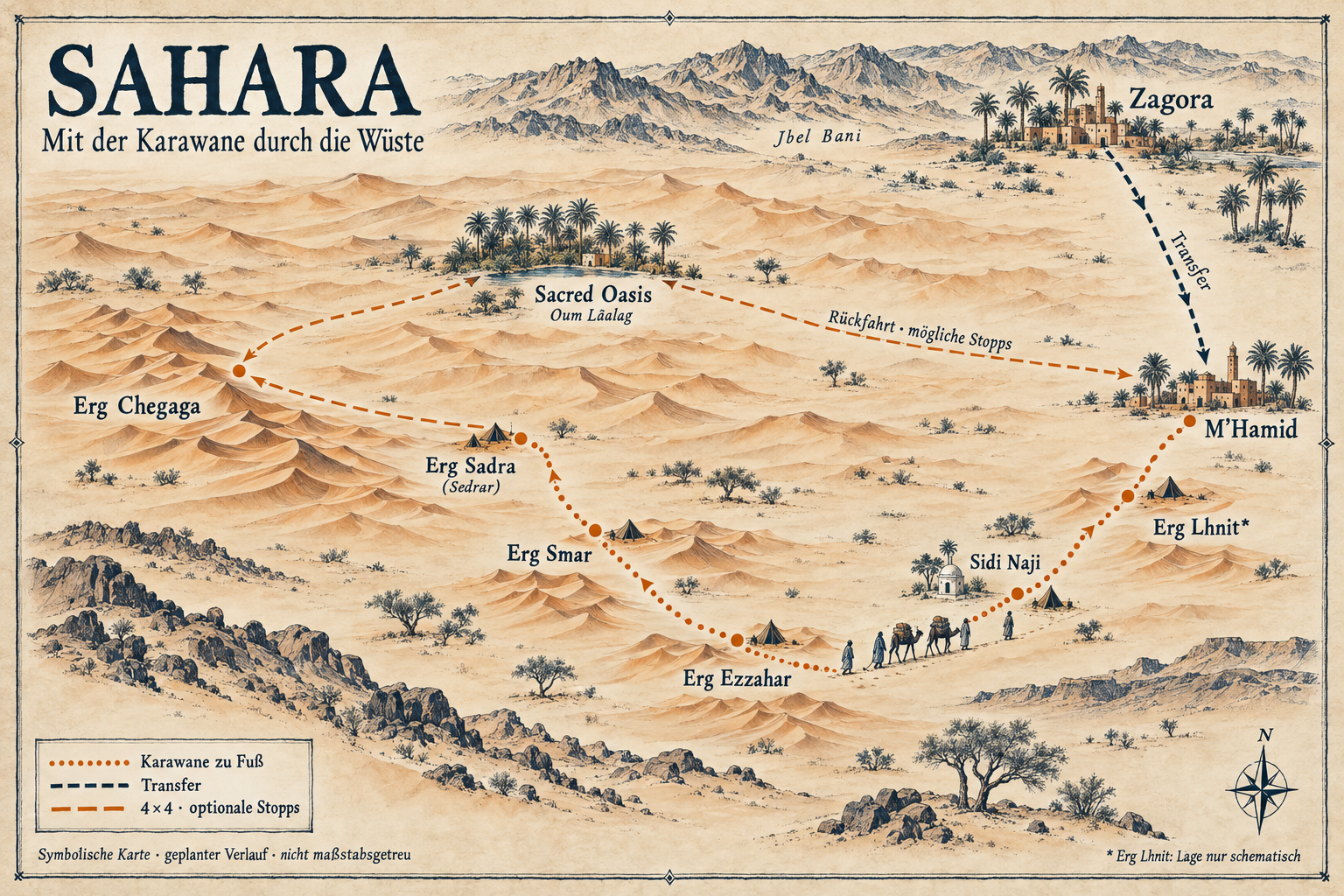
Arrival. Travel to Marrakesh and the first overnight stay.
Heading south. Transfer across the Atlas Mountains to Zagora. Arrival at the resort, introductions and preparation for the days ahead.
The caravan begins. Transfer to M’Hamid. There we meet our local guides and dromedaries and set out into the desert together.
Six days on the move. On foot, we travel from one campsite to the next through the Sahara. Each morning we set off; each afternoon we arrive in a new place.
Return. At the end of the caravan, 4×4 vehicles collect us and take us back to Zagora, where we spend our final night.
Journey home. Transfer back to Marrakesh.
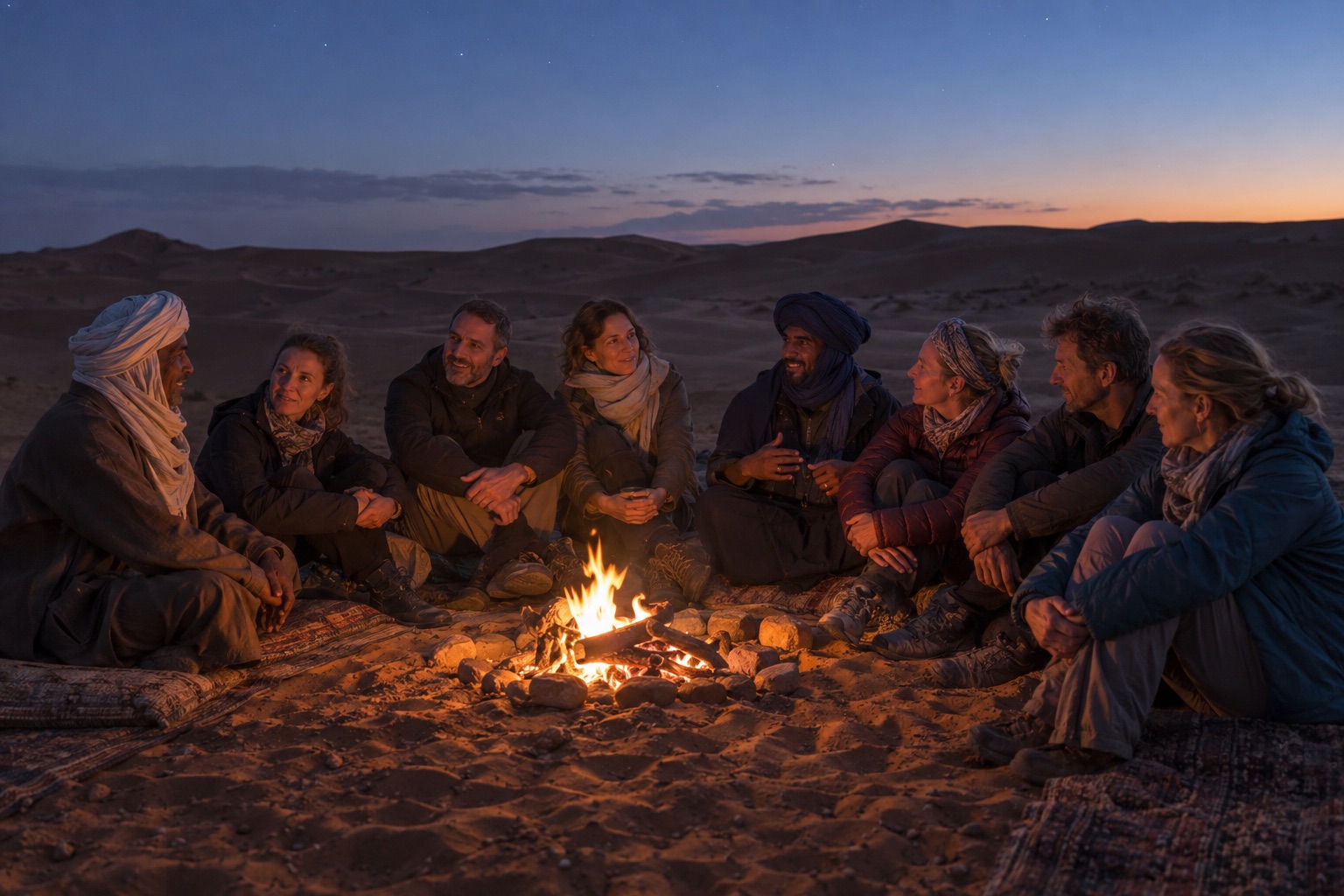
We sleep outdoors in the desert. A private tent is possible, as is sleeping under the open sky. What matters is that you stay warm at night and recover for the following day.
You carry only a small daypack while walking. Main luggage, equipment and provisions are carried by the dromedaries.
We eat together with our local guides. The food is good, simple and traditional, prepared on location.
Our drinking water is carried by the caravan for the days in the desert and is available in sufficient quantities along the way.
Washing facilities in the desert are simple and limited. Showers are available only where the route allows. During the desert days, the toilet is generally a discreet solution outdoors.
There is no blanket phone ban. At the same time, smartphones should take up as little space as possible during these days. A short daily window is planned for necessary communication with home.
No survival challenge, no wellness holiday and no seminar programme. We spend several days walking through the desert—carefully prepared and guided, with a simple daily life and plenty of time outdoors.
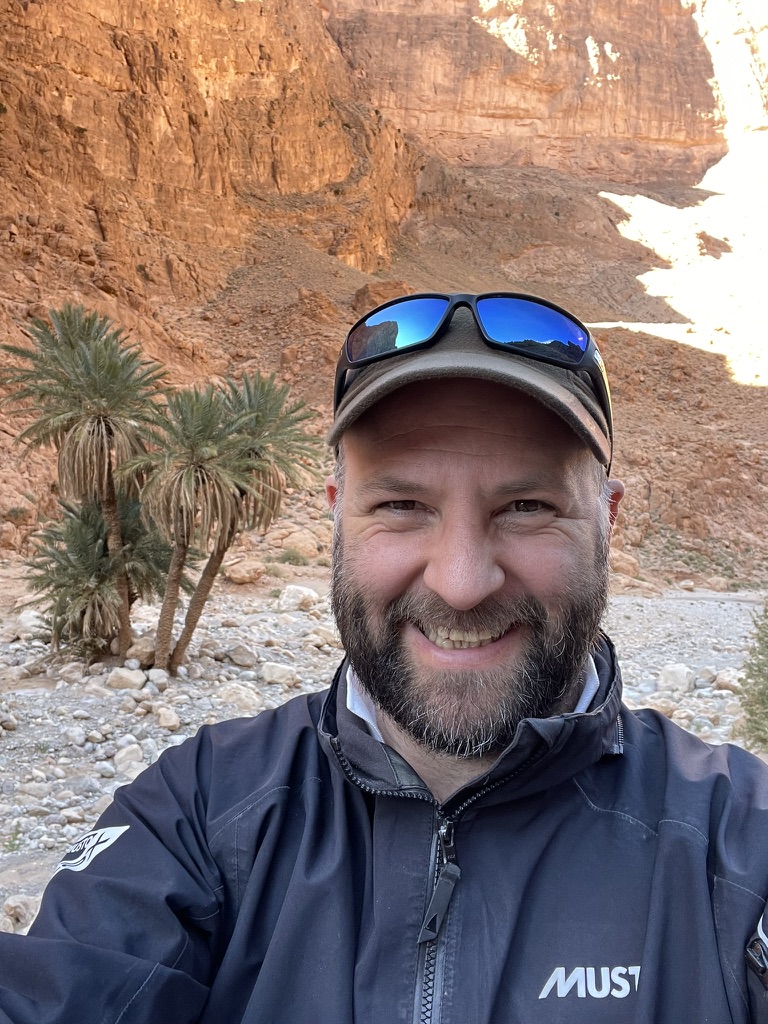
I am Elias, and I will be your personal point of contact throughout the retreat. The journey is carefully prepared and guided. Along the way, I work closely with our local guides. We travel together as one small group.
You need a moderate level of basic fitness, but no outdoor experience. Comfort has its place where it supports recovery and safety. Simplicity where it belongs to the experience.
More about meA moderate level of basic fitness is required. We generally walk for around four to five hours a day.
No. Outdoor experience is not required.
The mobile camps have small personal tents (approx. 2 × 2 m) and one large communal tent. Equipment includes a tent, an approximately 10 cm-thick sleeping mattress, a Moroccan rug, blankets, pillows and a sleeping-bag liner. Please bring your own sleeping bag and, if you wish, your own tent. In suitable conditions, you may also sleep under the open sky.
In January and February, daytime temperatures are normally around 20–30°C and night-time temperatures around 5–10°C. Additional blankets are available.
Drinking water is conserved for drinking, cooking and brushing teeth. Water from nearby wells is used for washing hands and kitchen tasks. A shower may be possible at an oasis, depending on conditions; there are no daily showers. The toilet is generally a discreet solution outdoors.
About six litres per person per day are planned for drinking, cooking and brushing teeth, plus a reserve. If more water is needed, it can be brought by camel or 4×4 vehicle.
There is good, simple, traditional nomad food. Breakfast is planned to include fruit, dates, olives, jam, honey and bread. Lunch consists of quick dishes such as cooked vegetables, rice and salad; dinner features different Moroccan tagines. Meat, dairy and other highly perishable products are not carried because there is no refrigeration.
Personal luggage should be limited to approximately 30 litres. While walking, you carry only a small daypack with the things you need immediately. The remaining luggage can be carried by the camels.
Yes. Helping to set up and take down camp, tend the fire, cook, manage water and care for the camels is an essential part of travelling together. Activities beyond the route, meals and camp setup are voluntary.
Reliable mobile reception is expected along the entire route. The caravan also carries mobile phones and first-aid equipment.
The entire route and every campsite can be reached by 4×4 vehicle in an emergency. Depending on the location, the expected driving time to the camps is around 30 minutes to a maximum of two hours. Elias and the local guides coordinate any necessary measures together.
If someone cannot continue walking, travelling by camel may be possible initially. In the event of illness or injury, evacuation by 4×4 can be arranged; the person concerned bears the cost. One person can be evacuated while the rest of the group continues the tour. The usual destination is the hospital in Zagora.
The main weather risks in January and February are wind and rain; strong winds or sandstorms are uncommon. If the weather affects safety, nearby permanent camps are available as alternatives. Elias and the local guides decide together whether to alter or stop the route.
Yes, you are very welcome to join on your own.
You will receive a detailed personal packing and equipment list in good time before the journey.
You first travel independently by air to Marrakesh, where we meet at a hotel. From there, a shuttle takes us via Zagora and M’Hamid into the Sahara. After the final night in the desert, the return drive to Zagora takes around three hours. The following morning, a shuttle travels to Marrakesh airport.
Before you decide, we talk personally. We clarify whether the retreat suits you and answer your open questions.
Arrange a no-obligation introductory call